| Mon, 01 Nov 2010 | #1 |
|---|---|
|
|
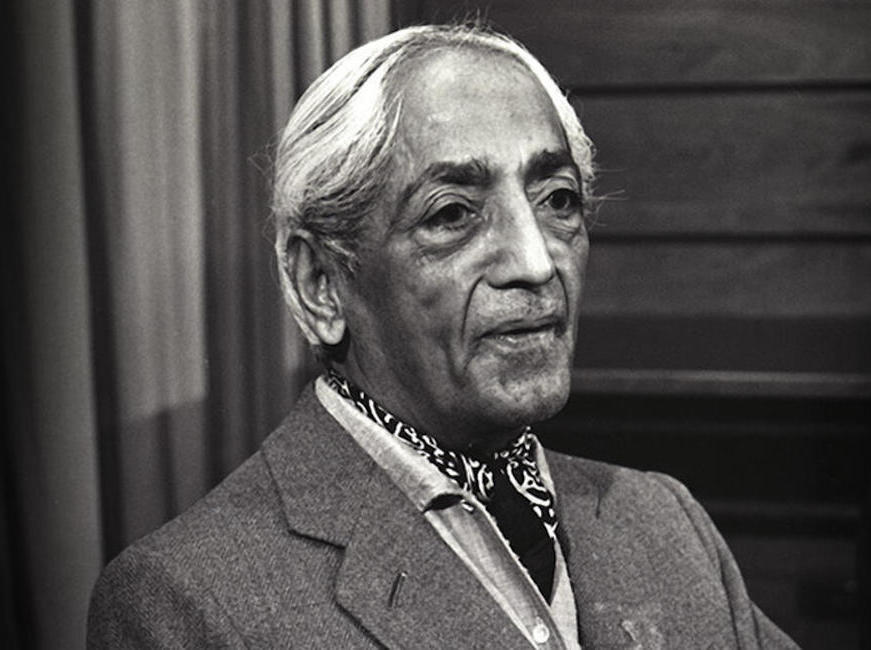
It just strikes me as funny- k talked about the ending of the self, ending of thought, and one might imagine him like some eternally silent, still Buddha, but when you see him in dialogue, he is energetic, humorous, passionate, intelligent, and very human as it were. It would seem that we cannot predict or formulate any outcome of the stillness of the mind or the ending of the self- really one can have no idea what does or doesn't lie beyond (so to speak). It's difficult to say this right; does anyone know what i mean? |
| Back to Top |
| Mon, 01 Nov 2010 | #2 |
|---|---|
|
|
Do you believe he was referring to a permanent state of no-self, no-thought? I'm not sure he ever said that, in fact, based on his writings, he provides no evidence of such a thing. I don't think such a state is possible, the character and personality will manifest when it needs to. What do you think? |
| Back to Top |
| Mon, 01 Nov 2010 | #3 |
|---|---|
|
|
Mike, ending of self is not synonymous with the ending of the various faculties of the mind. A quite, still mind is not carrying any psychological burden and will do everything more energetically, efficiently and passionately. FLOW WITH LIFE! This post was last updated by Dr.sudhir sharma Mon, 01 Nov 2010. |
| Back to Top |
| Mon, 01 Nov 2010 | #4 |
|---|---|
|
|
It is ironic that someone talked so much about silence. But it's also natural to want to share what is most important. And luckily he did. |
| Back to Top |
| Mon, 01 Nov 2010 | #5 |
|---|---|
|
|
He often spoke in his own kind of shorthand and one has to take a whole view of how his vision was expressed over the years. The vision did not change but the expression did. If we do not stand back we get a distorted, partial and literal view of certain phrases and sayings. Thought ends, but what thought? In later years he used the word 'thought' to describe the whole psychological structure based upon memory. In earlier writings he goes into more detail about memory. He said that we create memory out partially understood or misunderstood experiences. Memory is a confusion of fragemnts, lacking inherent meaning. Thought is the process of mulling over these shards and splinters, trying to piece them back together in such a way as to provide understanding. It is the effort to reach completion and it is this feeling of lack of completion that is our torment. But he also states that he does not include in this what he calls 'facts' or later calls 'technological knowledge.' Thought, in his later usage of the term, mainly means the personal history of pain and pleasure, the hurts and hindrances. This, he says, has to end; one has to put pay to the personal past. But not one's knowledge of facts, one's skills, crafte, vocational leaning etc. I started a thread some time back questioning whether or not there is something essential beneath our conditioning. K seemed to suggest that there was but he vehemntly denied that it was some super-soul or whatever. But, there is this background of tendencies, the uniqueness of each one of us that makes one person stupid and the other clever. K denied that there was equality. But he suggested that this background individuality had been swamped by external and internal pressures. Certainly in K's own case, one gets to enjoy (or not) his individual quirks, his humour, his hair and his perfectly shined shoes. He was a clearly defined individual and with or without the teaching one could not mistake him for someone else. He likes his fiction books, his cowboy films and his tea and cakes at Fortman and Masons in Picadilly. There was nothing grey about him. And do you really believe Siddartha was silent? No, that is just the statues! "The ego is first and foremost a body ego." S. Freud This post was last updated by Paul Davidson (account deleted) Mon, 01 Nov 2010. |
| Back to Top |
| Tue, 02 Nov 2010 | #6 |
|---|---|
|
|
Hi Mike, From what I've learnt of Krishnamurti, the ending of thought and silence means the ending of the constant chatter within the brain and has little if anything at all to do with forcing oneself to be physical still. It is a state of complete attention in which there is no centre/self. In this state there is even more energy. If you saw a snake crawling towards you in the forest, to give just one example, your mind would be instantly brought to silence and you would immediately take evasive action. |
| Back to Top |
| Tue, 02 Nov 2010 | #7 |
|---|---|
|
|
Is it in the field of knowing? If you talk about silence then thought is absent.So it's not produced by thought.So this cannot be in the armory of knowledge.So one thing seems clear to me.We won't be able to visualize this beforehand.If we do then it cannot the quality of a silent mind! Silence-no thought would mean no memory of this will be possible.So it will be living quality,a state.Will such a thing be communicable? |
| Back to Top |
| Tue, 02 Nov 2010 | #8 |
|---|---|
|
|
"Will such a state be communicable?" Right, that's what i mean... well, I just wanted to express my thoughts on this 'peculiarity', so to speak. For someone who seemed to deny the importance of "individuality"- wait, maybe that's it- he said somewhere, "We become second-hand human beings, which we are. The word individuality means indivisible. An individual means an entity who is indivisible, not fragmented but whole. And we're not. We're not individuals at all." That seemed something he was talking a great deal on, expecially later in his life. But again, thought's speculation on these things beyond itself, like 'wholeness', are futile. What's at hand is what we are. It would seem though that without burden or conflict, one would seem to have much more energy, passion, in what one does, as Dr. Sharma and others have said. And yes, Siddhartha was not always seated, silent in the lotus position, a beautiful symbol of his deep peace,though! |
| Back to Top |
Not a member yet? Create an Account