Krishnamurti & the Art of Awakening

Krishnamurti Quote of the Day

Early Writings, Volume VII | Talks at Adyar, India 1932-33

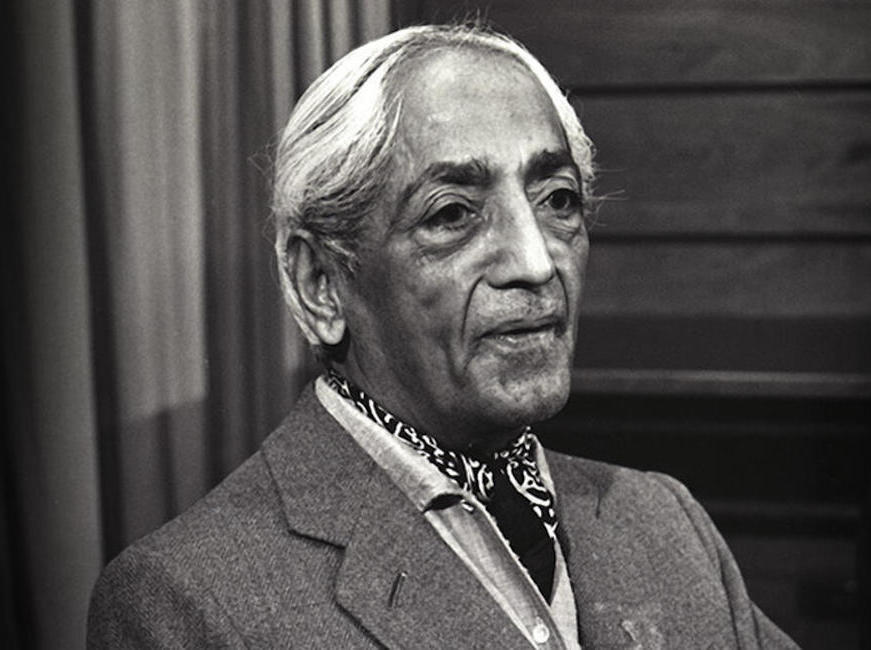
Question: Do you think that a thorough sceptic, or an intelligent atheist, or a man of few or no ideas, is nearer the realization of that truth of which you speak than a godly man, kind in heart and helpful to his fellowmen?

Krishnamurti: I say that neither the sceptic nor the godly man can realize truth if they lack true intelligence. It is not a question of belief, but of intensity of living. After all, a lunatic, as we call him, is but a man who is possessed by a single idea, with which he identifies himself, so we put him in an asylum. A man of many ideas, when he identifies himself with them, is also a lunatic. This, by the way, I was told by a very prominent doctor who happens to be the head of a lunatic asylum, and I am passing it on to you. Ideas are like water caught up in a vessel from a flowing river. If you cling to an idea it destroys you, as water held in the vessel becomes stagnant. But if you are yourself in the current, you are ever with the moving stream. Then there can be no attachment to a single idea. You can be free of an idea only through the intelligent understanding of its true value, but there is no understanding in merely giving up ideas or acquiring them. So let us for the moment forget the atheist and the godly man, the sceptic and the great believer. Each of them is consumed with an idea whereas I am talking of that living reality in which there is utter freedom from all ideas.

Tags: freedom

Related Quotes
We should go into this question of freedom and enquire whether it is at all possible to be free, or if it is an ideological utopia, a concept which has no reality whatsoever.
Only in total freedom does bliss exist.
From the known you cannot possibly see the unknown;
Freedom is to stand alone, unattached and unafraid, free in the understanding of desire which breeds illusion.
Only the mind that has emptied itself of the known is creative.
Self-knowledge is not a conclusion, an end; it has no beginning and no end.
It is only the righteous man that develops his will as a means of resistance, and a man of will can never find truth, because he is never free.
Meditation is seeing the constant touching the ever-changing movement of life.
We have divided life into dying and living. And this division has brought about great fear. And out of that fear we invent all kinds of theories, very comforting, may be illusory, but it is very comforting, illusions are comfortably neurotic.
The 'me' is created by thought and the 'me' says: "I am independent of thought".
Freedom is born of the perception that freedom is essential.
Everything we see, every thought we have, shapes our mind; whatever you think now, whatever you have thought in the past and whatever you are going to think in the future, it all shapes the mind.
The mind is never free, pliable, for it is always anchored; it moves within the radius, narrow or wide, of its own centre.
If I have the whole picture in mind then I can take in the detail; but if my mind only operates in a detail then I cannot take in the whole.
I cannot lead you to truth, nor can anyone else; you have to discover it every moment of the day as you are living.
How can one stimulate a desire for freedom?
To live without comparison is to remove a tremendous burden.
To examine, explore, anything, there must be the quality of freedom from all your prejudices, conditioning and so on, even from your own experience;
You may say there is a part of you - the watcher, the super-soul, the Atman - which is not conditioned; but because you think about it, it is within the field of thought, therefore it is conditioned.
We are influenced not only by external conditions, but also by an inner condition which we develop.