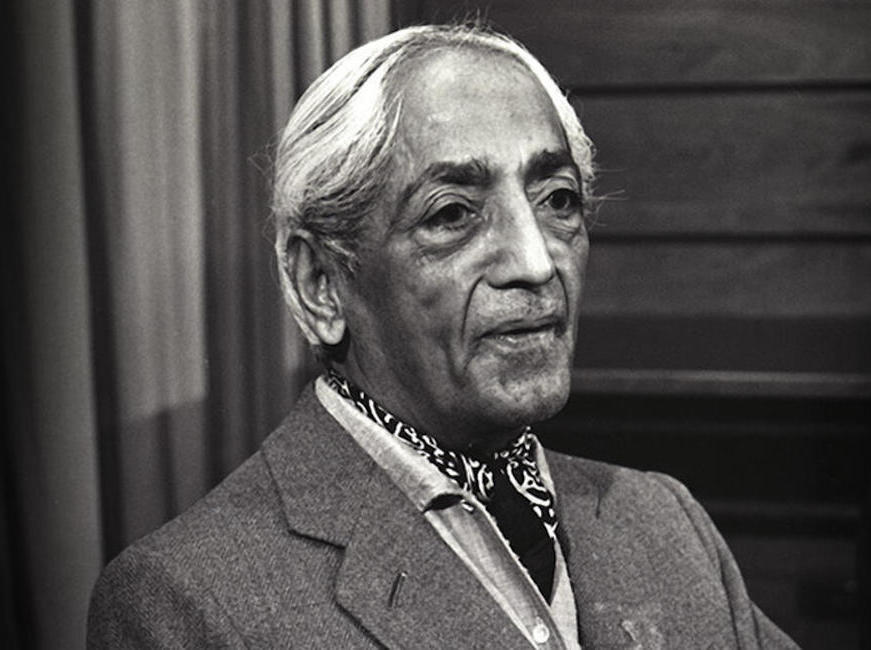
The Mirror of Relationship: Love, Sex and Chastity | Third Talk in New Delhi, 1966
Krishnamurti: I will explain, sir. The questioner asks: ''You said that in attention there is no memory; how am I to be free of memory? '' Right, sir?
Sir, when you know the machinery, the significance, and the structure of anything, then you begin to understand it. Then you can put it aside; then you are really free of it. You understand?
I must stop, sir. It is seven o'clock. This is the last question.
The questioner says that a human being is burdened with memory. To understand memory, you must first see the structure of memory, how it comes into being, and what its place is, and also where it must not interfere. You know how memory comes, sir? Do you know the beginning of memory? I see a beautiful face; there is perception, sensation, contact, and desire. You follow this, sir? This is the process, isn't it? I see something - a sunset, a face, a tree - and there is visual perception; from that there is sensation; then the desire to touch it, sensation; then thought comes in and says, ''That gives me pleasure, I must have more of it.'' Right?
So, thought generated by sensation, desire, prolongs the pleasure principle. Where there is pleasure, there is pain, and the battle is on. And so memory becomes thicker and thicker; the older, the more traditional it is, the more heavy it becomes. And then you say, ''How am I to get rid of it?'' You cannot. All that you can do is to observe in the minutest detail how it comes, how it begins. And, to discover how it begins, your mind must observe silently. You understand, sir? To discover anything you must look; and to look, your look must be silent. Sir, if you look at your husband, your wife, or child, if you have any ideas about that child, or about the image of your wife or your husband, then you are not silently looking; your mind is cluttered up with all these things, and therefore you cannot look. So, to look, your mind must be silent, and the very urgency of looking makes the mind silent. Not that you first have a silent mind and then look, but rather the very necessity of looking at the world's problem and therefore at your problem - that very urgency of looking makes the mind quiet, silent. That very look makes the mind silent, and then you can look at your memory and the beginning of the memory. The demand to look at your memory and to find out how it begins - that very demand makes the mind silent. Then you can look at the beginning of every movement of memory.
Tags: memory
Not a member yet? Create an Account