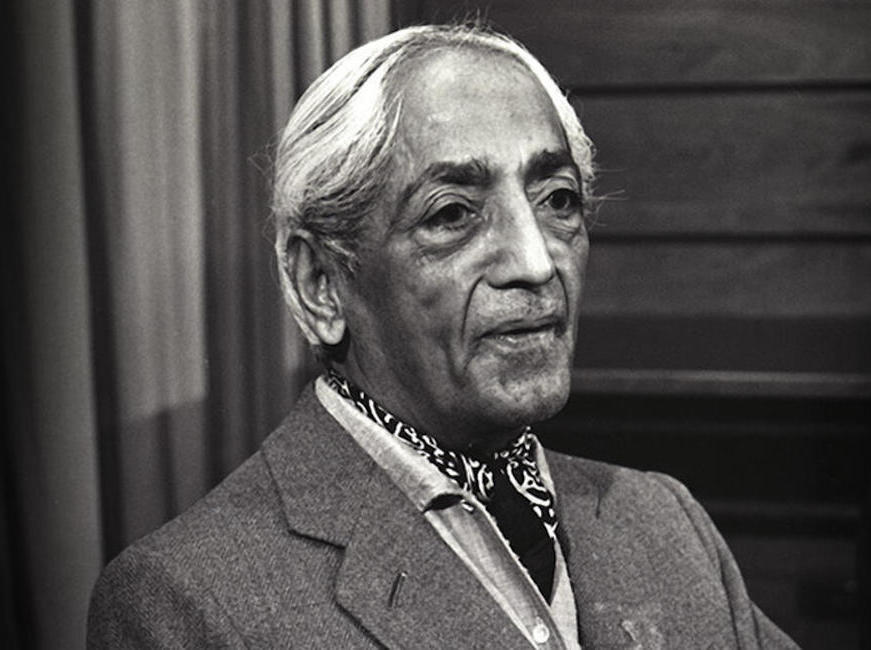
I first encountered the teachings in 1956 and was deeply affected by them . My
life since then has been an inner dialogue between the teachings and the realities and pressures of my life . For many years I met no one who had even
heard of K .In the late 70s and early 80s I went through a very creative period
and visited Brockwood several times . My close family see my interest in this
sphere as something rather odd !.
During the last 10 years I have broadened my enquiry in the direction of
Buddhism where personal contact is easy to come by and was a member
of a small group of seekers after truth but this has petered out . Recently I
have rather given up on any kind of spiritual quest . The reason for this is a
realisation that such evidence as there is suggests that when the body and
the brain physically die , that is the end of individual consciousness . So why
bother ? K has always dodged this one . If I am nothing (and that is what K
would like us to be ), what is the entity that is enlightened and bears
responsibility as an agent ? This is a fundamental paradox in the teachings .
What I would like is to discuss this issue with other members of the
network who identify this as central and fundamental .
It depends on who is in the group . Intelligence is about independence of mind
and group discussion tends to be a social rather than an enlightening
experience .Subtlety is about awareness and observation which is usually
best done within oneself .Group discussion can stimulate and suggest new
approaches but the hard work has to be done alone
Are you sure ? I think he said many times that you must doubt everything .
K had no time for Dale Carnegie! Surely if you tie yourself up in knots ,this
means that you are intellectualising . Intelligence implies freedom from
conclusions whether positive or otherwise .
On the whole , it is not advisable ! If you want to convey the teachings , I have
found it best to present them as my own . It is fatal to talk about this
great Indian philosopher with a funny name!
Mainly these days by spontaneously realising that I am embroiled in
non -awareness ,stopping and looking at the landscape of my mind . I usually
cannot maintain this awareness for more than a few seconds
At worst , they will become a foot note in the history of Buddhist thought .I
think it more likely that the prospects are better than this . The teachings are fully
consonant with the values of the European Enlightenment and the approach to reality which we call the Scientific Method . Both of these are deeply rooted in
important civilisations which barring a nuclear or other catastrophe will survive and prosper .
Less than I would wish! The main effect has been on my general outlook and
motivation . I would have been much more ambitious in the worldly sense had
I not encountered them . In times of crisis they have given me the ability to
handle my reactions and feelings by seeing myself as an ingredient of the
crisis rather than on the receiving end of it .
This is what happens ! If you are not careful you become a Krishnamurtiite as
part of your personal identity . All you can do is see it and laugh at yourself.
A thinker of his stature is born about once in 500 years so he is exceptional
alright . The teachings have been out there about 80 years -not a bad trial
period .They have had considerable success in influencing people but very little
in transforming them . The question is how do you make the teachings
teachable .Unless you can change people quickly and in large numbers what
you are doing has no socio-political significance . Part of the problem lies in
the congenital inadequacies of the average man interacting with the interests
of the able elite .The only answer to that if the technology becomes available
reliable and safe is to re-habilitate eugenics and reduce natural inequality !
The questioner is more important than the question .The problem solver is
the problem .Do not seek salvation ;seek the facts of the present moment .
Yes and it is very difficult and very frustrating if you hope for too much .
View all answers to this questionI am not happy with the phrasing of the question . You are not required to believe
anything so why talk of plausibility ? Neither are you required to accept anything .If you were to ask what the greatest weakness of the teachings is I would say it
is that it seems to throw out the baby with the bath water . What people want is salvation and survival beyond physical death . They want self improvement not
annihilation .
Either or both .
View all answers to this questionThere is no reason why a checklist of challenging questions could not be drawn up which could be addressed to the mind and the psychological response
observed .One needs ways to increase the frequency and intensity of
self discovery .
No recent activity recorded.
You must be logged in to leave a comment.
Not a member yet? Create an Account
1 Comment
hello, read your profile summary, and just wanted to comment. i really do think he answers this. actually, he does, but it isn't in what he says, it's in the actual living of it.
when we say "why bother", that is the self that wants something to achieve. when the fact is seen without motive, which is an insight into the whole working of motive, then the whole conflict behind the question disappears.
if there is any point, it's that so many people are unnecessarily suffering, and are unable to understand what is going on, because there is something stopping them from listening.