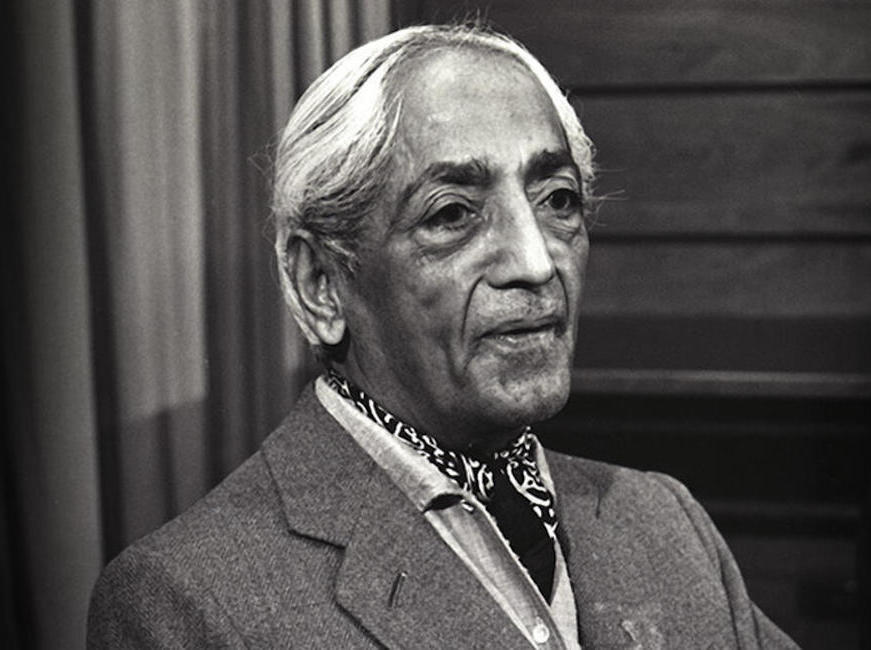
I'm seriously interested in the Teachings. I'm really not interested in anything else.
We have a good dialogue group in Copenhagen. It is growing.
I congratulate Dev and co. on this site. It is well made. I'm doing one myself. It is an introduction to Krishnamurti in Danish. Mainly in his own words. It is a lot of work.
Krishnamurti substantiates non-duality like no one else. Listening to him heals you, if you don't make it into a ideology.
His message is not an injunction to be "in the now" or "good", which is still duality, control. It is a clear description of the horrors of being conditioned by dos and donts and the ensuing conflict.
A conditioned mind is limited. It can't solve human problems. That is what is wrong with the world, and that is why Krishnamurti is relevant not only for religious seekers, but for everybody.
To the very serious person, group dialogue has little importance. The real work you have to do yourself.
(I can't help thinking, though, what it would like be to be with somebody who had gone deeply into these matters).
On the other hand, the first step is the last step. One subtle point, choiceless awareness, can be demonstrated to a degree in a group and perhaps inspire people. I have written about this in The LINK issue No. 28.
When Krishnamurti says that in the old days such a sensitive body (as his) would be looked after by a group of disciples, I feel that there could be the seed of a new (ancient) division between people: the priests that live a protected life and all the rest.
Is it that with an enlighened person everything has to be so perfect that he can't work? Working would destroy his fine tuned sensitivity. In that case we can only hope that the machines will take over.
All of the above. But the more you study yourself, the deeper you understand the teachings.
View all answers to this questionNo, I won't enter into that kind of thinking. I suspect that the reason why we find his teachings impracticable is that we really don't understand what he is saying. The core of it eludes us.
But maybe a new insight, a new learning set is spreading among us and all of sudden it will seem quite natural.
With friends, family and colleages I never take the initiative. I don't want to sound like a preacher. However, if I do get into a deep conversation with somebody, or if somebody is interested in what kind philosophy I seem to be so involved in, what do I do?
Try to explain it? That´s difficult in a few words...Give them a book? I simply never get the book back, because they haven't got down to reading it and eventually forget all about it.
Neither is optimal, when they are just curious. That is why I'm making a introductory website in Danish with special consideration to windowshoppers (I hope it is also interesting for people who know Krishnamurti already). (www.krishnamurti.dk)
On the home page have a little titbit for every relevant target group and so on. Most websides on Krishnamurti assume that the visitor is already "converted" and can't be frightened away.
I think that if there was a well made introductory website in every language, we would get more newcomers.
I think Krishnamurti was exceptional, but eventually a lot of people will change.
At present we use thought a lot. Our urban life is highly techological and highly organised. We have to navigate a psychologically complex human evironment. Krishnamurti called it "our beleaguered existence" - with its double connotation of crisis-stricken and under siege. Sensitive people can't live under these conditions forever and we are not mentally equipped to find our way out. So there is a deep logical nessecessity for the change Krishnamurti proposes. It is not a choice that certain privileged people can make, it is forced on us by life.
I think it has hardly started. The teachings are the seeds of a new culture. Krishnamurti is a catalyst, because he has seen the absolute necssecity of this change more clearly than anybody else. But he is not the inventor. It is a logical, inevitable next step in the development of man. There is either that or degeneration.
Ifyou try to interpret it in the mystical tradition it will suffer, because it becomes exclusive and surrounded by humbug, but it will survive.
The chain reaction takes a long time in the beginning...
Doubting can become a habit. If self-knowledge is merely an intellectual hobby, and you have not experiemented with it yourself, you can always ask, "how do you know that". After all, you can't prove anything. Dialogue must be based on a communication whose nature is empathic.
But the Krishnamurti's statement can be dangerous, because there are always totalitarian people who are against questioning. They are in the "K-world" as well.
Dialogue comes about spontaneously all the time. I havn't made up my mind how important oraganised dialogues really are, but I think they are one way of spreading and "digesting" insight. Like this site.
However, if the dialogue is arranged, it must be highly organised. It demands a lot from the participants. The format, the facilitating and the rest of the formal framework must be given a lot of thought. If the subject is not quite clear to everybody, the confusion will distract people and the whole experience will be disapointing.
No recent activity recorded.
You must be logged in to leave a comment.
Not a member yet? Create an Account
2 Comments
Hi Rasmus,
I like your innocence. I am following your activities henceforth.
Hello Rasmus!
Read your article on bringing confusion...
A very clear and clarifying piece of work. Interesting reading, thank you so much!
Per